This guide explains how to correctly size a non-electric, water-powered proportional dosing pump for low-flow water lines. It focuses on three field-critical topics: (1) start-up thresholds (minimum flow and pressure to initiate and sustain cycling), (2) ratio stability under hydraulic transients, and (3) suction-side constraints (lift, line losses, viscosity and air ingress). You will find practical sizing and commissioning rules to limit under-dosing, over-dosing, and loss of prime in industrial water loops and treatment skids, including ultra-low ratios such as 0.03% (1:3000).
Why low-flow sizing matters
Typical drivers for water-powered dosing
Non-electric proportional dosing pumps are often selected to eliminate local electrical power, simplify installation on remote sites, and reduce the number of components (drives, control panels, wiring) that can fail. In potentially explosive atmospheres, using equipment designed for such environments can also reduce constraints around ignition sources, provided the overall installation is engineered and assessed accordingly (equipment directive 2014/34/EU (ATEX)).
Why low-flow lines are unforgiving
On low-flow water lines, the dominant sizing risk is not the ratio setting itself, but insufficient hydraulic margin to start and maintain stable cycling. When the installation routinely operates close to the minimum flow or minimum pressure of the pump, the system becomes highly sensitive to small disturbances (filter fouling, minor pressure losses, demand swings), which directly degrades dosing repeatability.
Where low-flow proportional dosing fails
Underestimated start-up energy
The most common failure mode on low-flow installations is no-start or intermittent cycling. Typical root causes include intermittent consumption (fast valve events), long small-diameter distribution lines, and pressure regulators that stabilize pressure but reduce the usable differential pressure at the dosing point. The result can be incomplete strokes, stop/start cycling, and unstable dosage during start-up and flow ramps.
Ratio stability impacted by transients
"Proportional" performance in the field depends on remaining inside the defined operating envelope of the pump and ensuring repeatable strokes. On low-flow lines, a small absolute change in flow represents a large percentage change, which amplifies instability. Under-dosing typically appears when cycling becomes irregular at the low end; over-dosing can occur after disturbances if suction-side compressibility (air) delays dosing and the system later "catches up".
Suction-side issues dominate drift
At ultra-low injection ratios, the concentrate flow is extremely small, so parasitic effects become dominant: micro-leaks that ingest air under vacuum, partial hose collapse, poor check-valve wetting, or restricted container venting. Air ingress is particularly damaging because it increases compressibility in the suction line and disrupts stroke repeatability, increasing the risk of de-priming. This effect is amplified around ratios such as 1:3000.
Regulatory constraints influence architecture
In hazardous areas, equipment selection may be constrained by the ATEX equipment framework (Directive 2014/34/EU). For drinking-water and disinfection duties, system designers should also consider requirements related to treatment chemicals and materials in contact with water intended for human consumption under the recast drinking water directive (Directive (EU) 2020/2184), and applicable national transpositions. In addition, protecting potable water networks against backflow contamination is a standard design topic in dosing installations (see NF EN 1717).
Technical sizing method
Step 1: define the true operating envelope
Low-flow sizing must be based on the minimum and maximum real operating conditions at the dosing location, not on a single design point. Capture (measured when possible): minimum steady flow, minimum transient flow during start/stop events, minimum and maximum line pressure at the dosing point, and the frequency/amplitude of fluctuations. For centralized industrial loops, document worst-case combinations (lowest pressure coinciding with highest demand, and lowest flow when only one user remains open).
Step 2: verify start-up thresholds with margin
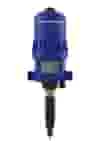
To avoid no-start and intermittent cycling, apply a simple design rule: your expected minimum flow and minimum pressure must exceed the pump's minimum specifications with margin (to absorb fouling, seasonal viscosity changes, and valve wear). For example, the Dosatron D9IL3000 is specified for an operating water pressure down to 0.15 bar, which can be relevant on low-pressure loops, but the installation must still maintain a robust margin under real transients.
Step 3: protect ratio stability against hydraulic swings
Stable proportionality requires both (1) a repeatable hydraulic drive regime and (2) a suction line free of compressibility. Practical measures include:
Install the pump where hydraulics are least turbulent (avoid immediately downstream of fast-acting valves or directly after pumps without dampening volume).
Reduce unnecessary pressure losses (overspecify filters where justified; avoid restrictive fittings) to keep the system away from minimum pressure thresholds.
Validate ratio stability by mass/volume balance over a defined throughput (e.g., chemical consumption per m3 of water) rather than short snapshot readings that over-represent transient behavior.
Step 4: engineer the suction side as a metering subsystem
On low-flow dosing, the suction side is part of the accuracy chain. Engineer it explicitly:
Minimize suction lift: place the chemical container close to the dosing unit and preferably at or above a favorable level to reduce vacuum demand.
Keep tubing short, stiff, and chemically compatible: select tubing that resists collapse under vacuum and remains stable across temperature ranges.
Assure sealing integrity: micro-leaks often do not drip outward; they ingest air under vacuum. Minimize adapters and verify all joints.
Manage foot valve and strainer: keep the strainer clean, ensure the foot valve remains submerged, and avoid vortexing at low tank levels.
Control viscosity-driven losses: if additives are viscous, reduce suction losses by increasing suction diameter where appropriate, shortening the line, avoiding sharp bends, and considering temperature management or dilution when justified.
Ensure proper container venting: restricted venting can create container vacuum and mimic suction failure.
For suction diagnosis, treat NPSH (Net Positive Suction Head) as a useful engineering concept: cavitation and suction instability occur when the available suction head becomes insufficient relative to the pump's needs, especially when suction lift and friction losses increase.
Step 5: commissioning checks for low-flow dosing
Commissioning must prove both "it runs" and "it remains proportional under worst-case conditions":
Confirm continuous cycling at the minimum flow/pressure case (no stalling, no incomplete strokes).
Verify ratio by comparing concentrate drawdown against a measured water volume; repeat across different flow states.
Check suction tubing for persistent bubbles during operation (indicator of air ingress, poor wetting, lift/viscosity limitations, or venting issues).
Re-test after induced disturbances (closing/opening downstream demand) and verify recovery without de-priming or ratio drift.
Equipment mapping for ultra-low ratios and ATEX
Ultra-low ratio dosing (e.g., 1:3000)
For ultra-low ratios on low-flow industrial loops, prioritize a pump designed for such ratios and verify that the operating envelope (flow and pressure) remains stable on the low end. A typical match is D9IL3000, which is positioned for very low dosage proportional applications and is specified for low operating water pressure on the water-drive side.
Hazardous areas (ATEX) with unstable hydraulics
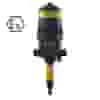
When the dosing point is located in a hazardous area, equipment may need an ATEX-certified configuration aligned with the site zoning and risk assessment under the ATEX framework (Directive 2014/34/EU). For proportional dosing in such contexts, a relevant option is D8IL3000 EX, specified for operating water flow rates from 500 to 8,000 L/h and operating water pressure from 0.2 to 8 bar, with an injection ratio range covering 1:3000 to 1:800.
Limits and early warning signs
Design boundaries you should not ignore
Operating too close to minimum thresholds: if the line frequently drops below minimum flow/pressure, the correct action is to re-architect (relocate the dosing point, reduce pressure losses, add buffering volume, or select a pump designed for lower thresholds).
High suction lift with viscous chemicals: even if water-side hydraulics are within specification, suction constraints can drive intermittent air intake, partial strokes, and long-term drift, especially at ultra-low ratios.
Entrained gas and outgassing: some concentrates release dissolved gas with pressure/temperature changes, which can mimic air leaks. Mitigation may require container handling practices or alternative concentrate management.
Backflow protection and potable water interfaces
Where dosing connects to potable or potentially potable networks, include a documented backflow protection strategy consistent with NF EN 1717 and the site's risk category. This is an engineering and compliance topic distinct from dosing accuracy, but it can strongly influence the hydraulic layout and pressure losses at the dosing point.
Future perspective
Making low-flow dosing more predictable
Over time, the most robust improvements typically come from better measurement and standardized commissioning practices (short-term pressure/flow logging at the dosing point, vacuum integrity checks on suction lines, and early viscosity characterization), which make sizing decisions more repeatable across sites.
Key takeaways
Three pillars for reliable low-flow proportional dosing
Sizing non-electric proportional dosing on low-flow water lines is primarily a margin exercise: hydraulic margin (start-up and continuous cycling) and suction-side margin (stable concentrate delivery). If minimum flow/pressure thresholds are not respected, dosing may not start or can stall; if transients are ignored, proportionality drifts in real operation; and if suction constraints (lift, line losses, viscosity, air ingress) are not engineered, ratio stability degrades even when the water line is in spec.
When to involve DOSATRON
When these principles are applied, DOSATRON water-powered proportional dosing is well suited to ultra-low ratio injection on low-pressure loops and proportional dosing under unstable hydraulics, including hazardous-area applications when an appropriate certified solution is required. For a project-specific selection and validation approach (operating envelope, suction design, and commissioning protocol), request a quote and technical review from DOSATRON.
Call to action: Describe your minimum/maximum flow, pressure range, target ratio, chemical properties (viscosity vs temperature), and suction layout, and ask DOSATRON for a quotation and sizing confirmation for D9IL3000 or D8IL3000 EX.