Variable-flow water networks (irrigation manifolds, livestock watering, building services, industrial wash lines, mobile CIP skids) expose proportional dosing systems to pressure and flow transients, evolving pressure losses and suction-side constraints. This technical guide explains why ratio control drifts in the field, how pressure, backpressure and refill dynamics affect water-driven proportional dosing pumps, and how additive properties (viscosity, outgassing, crystallization, compatibility) can reduce volumetric efficiency. It also provides engineering practices to stabilize dosing, verify concentration correctly, and separate true injection accuracy from process residual behavior.
Why dosing accuracy degrades in variable-flow networks
Variable-flow water networks (irrigation distribution, livestock watering lines, building services, industrial wash lines, and mobile CIP skids) are challenging environments for maintaining a stable chemical injection ratio. Even when the target setpoint looks straightforward (for example 0.2% sanitizer, 1% detergent, or 50 to 200 ppm free chlorine), real installations experience pump start/stop events, control-valve throttling, progressive filter fouling, intermittent demand, and local pressure drops. These events change flow rate and differential pressure across the dosing equipment, which can translate into concentration deviation at the point of use.
Three coupled mechanisms drive drift and instability
In practice, proportional dosing stability is governed by three domains that interact continuously:
Hydraulic operating limits of the dosing technology (minimum flow, minimum/maximum pressure, allowable pressure loss, and water quality constraints).
Pressure effects and transients (changing backpressure, pressure waves, and shifting differential pressure conditions).
Additive properties such as viscosity, density, vapor pressure (outgassing), solubility, and material compatibility.
This article describes these mechanisms and the field methods used by DOSATRON International application teams to keep ratio control stable outside laboratory conditions.
Field symptoms: drift, pressure swings and refill limits
What "proportional" means under real hydraulic variability
On variable-demand networks, proportional dosing is often expected to remain correct while the carrier flow varies by one to two orders of magnitude, from a few hundred liters per hour to tens of m3/h. Typical architectures include:
Water-driven proportional dosing pumps (hydraulic motor coupled to a dosing piston).
Electrically driven metering pumps paced by a flowmeter (pulse input).
Centralized chemical skids with PLC-controlled instrumentation.
All can perform well, but each is sensitive to constraints that are frequently underestimated during design and commissioning.
Hydraulic operating envelope and ratio stability
Any proportional system has an operating envelope defined by minimum/maximum flow, minimum/maximum pressure, acceptable pressure loss, and water quality (solids load, scaling tendency). When the network operates below minimum flow, the drive mechanism may not cycle correctly, leading to under-injection or intermittent dosing. When pressure is too low, suction conditions can deteriorate and refill becomes unstable; when pressure is too high, mechanical stress and seal wear increase, which can degrade accuracy over time if preventive maintenance is not matched to actual cycling duty.
Pressure effects: differential pressure, backpressure and transients
In variable-flow networks, pressure at the doser inlet and outlet can change rapidly. Sudden valve closures and pump trips can generate pressure waves; throttling shifts differential pressure; filters clog progressively and add head loss. These phenomena affect:
Hydraulic motor torque and cycling dynamics.
Dosing piston refill time (especially at high cycling frequency).
Check-valve opening/closing behavior on the chemical side.
A frequent field observation is apparent ratio drift at the point of use: the dosing device may inject correctly per stroke, yet local mixing, residence time and stratification cause concentration to vary during transients.
Suction-side limitations and cavitation-like behavior
The chemical pickup side is often the weakest link. Long suction lines, small internal diameters, high-viscosity products, low temperatures, partially clogged foot valves, or micro-leaks that ingest air increase suction losses and reduce refill quality. If the dosing chamber does not fully refill at the required cycling speed, the system under-doses. Although this is not identical to water-side cavitation, the symptoms can look similar: loss of prime, irregular dosing and bubbles in the suction line.
Additive properties: viscosity, outgassing and precipitation risks
Additives can be Newtonian or non-Newtonian, and viscosity may change with temperature and shear rate (typical for concentrated detergents, soluble oils, polymers, or emulsions). Higher viscosity increases suction-line pressure loss and slows check-valve response. Some products outgas due to higher vapor pressure, forming bubbles that reduce volumetric efficiency. Others can crystallize or precipitate during dilution, especially when water hardness and mixing conditions promote scaling or salt formation. These deposits can foul check valves and progressively reduce dosing repeatability.
Compatibility and drinking-water constraints
Oxidizers (for example hypochlorite), acids and some solvents require compatible wetted materials and attention to stress cracking, seal swelling and permeation. Elastomer degradation can create internal leakage: the installation continues to run, but the delivered concentration decreases.
Engineering methods to stabilize proportional dosing
Design the doser as part of a coupled hydraulic-chemical system
Maintaining dosing accuracy under variable flow requires evaluating the dosing device, the water network hydraulics and the chemical pickup system as an integrated system. With water-powered proportional dosing, the injected volume is mechanically linked to carrier flow, which inherently tracks flow variations, provided the installation remains within hydraulic limits and the chemical side refills reliably.
1) Define and protect the hydraulic operating envelope
Minimum flow and minimum pressure discipline. Select and size equipment based on the lower end of the real operating profile, not only peak flow. In networks with intermittent demand, engineering options can include a bypass loop or minimum recirculation flow to keep operation above the doser's minimum drive requirement.
Pressure loss management. Control pressure drops across upstream filtration and downstream restrictions. Where fouling is expected, oversize filtration and monitor differential pressure so maintenance is performed before head loss pushes the doser outside its stable zone.
2) Control transients and backpressure conditions
Hydraulic damping. Where fast transients exist (pump cycling, quick-acting valves), consider water-hammer mitigation measures (appropriate valve closing times and surge damping solutions) to reduce mechanical stress and maintain stable cycling behavior.
Backpressure repeatability. If downstream pressure fluctuates, a controlled backpressure strategy (application-dependent) can improve check-valve behavior and stabilize dosage repeatability, especially at low flow where small disturbances have a larger relative impact.
3) Engineer the chemical suction line for full refill
Minimize suction losses. Keep suction lines short, increase diameter when viscosity is high, avoid unnecessary elbows, and ensure airtight connections. Place the chemical container close to the doser and respect the maximum allowable suction lift recommended by the manufacturer. Use suitable foot valves and strainers to prevent particulate ingress without introducing excessive restriction.
Air management and priming discipline. For products that outgas or foam, reduce agitation in the container, keep the suction strainer sufficiently submerged, and formalize priming procedures after drum changes. Air ingestion is a frequent cause of instability that is mistakenly diagnosed as "ratio drift".
4) Match additive behavior to the dosing technology
Viscosity-aware configuration. For viscous or shear-sensitive products, validate performance at the lowest site temperature (worst-case viscosity). If necessary, use adapted suction hardware, dilution staging, or temperature management to remain within refill limits.
Compatibility-by-design. Select wetted materials compatible with oxidizers, acids and alkalis. For hypochlorite, consider storage and line design that limits heat and UV exposure to reduce decomposition and the formation of by-products that can accelerate fouling.
5) Verify accuracy with a chemistry-aligned measurement plan
Separate injection accuracy from process residual. When feasible, verify injection ratio by mass balance: compare chemical container mass change over time to metered water volume. Then validate process residual (for example free chlorine) at a sampling point that reflects adequate contact time and representative mixing.
Use step tests under variable flow. Intentionally vary demand (open/close branches) while logging flow, pressure and residual to identify whether deviations correlate with hydraulic transients, suction refill limits or reaction demand.
In practice, the most repeatable results come from combining correct sizing, stable hydraulics, suction-line engineering, compatibility checks and verification protocols that reflect the real process conditions.
Applying proportional dosing to disinfection and industrial treatment
For applications requiring water-powered proportional dosing without electricity, DOSATRON International provides dosing families aligned with industrial dosing, disinfection and water-treatment use cases, including:
D3IL10 for industrial proportional dosing applications where stable ratio control is required across variable demand.
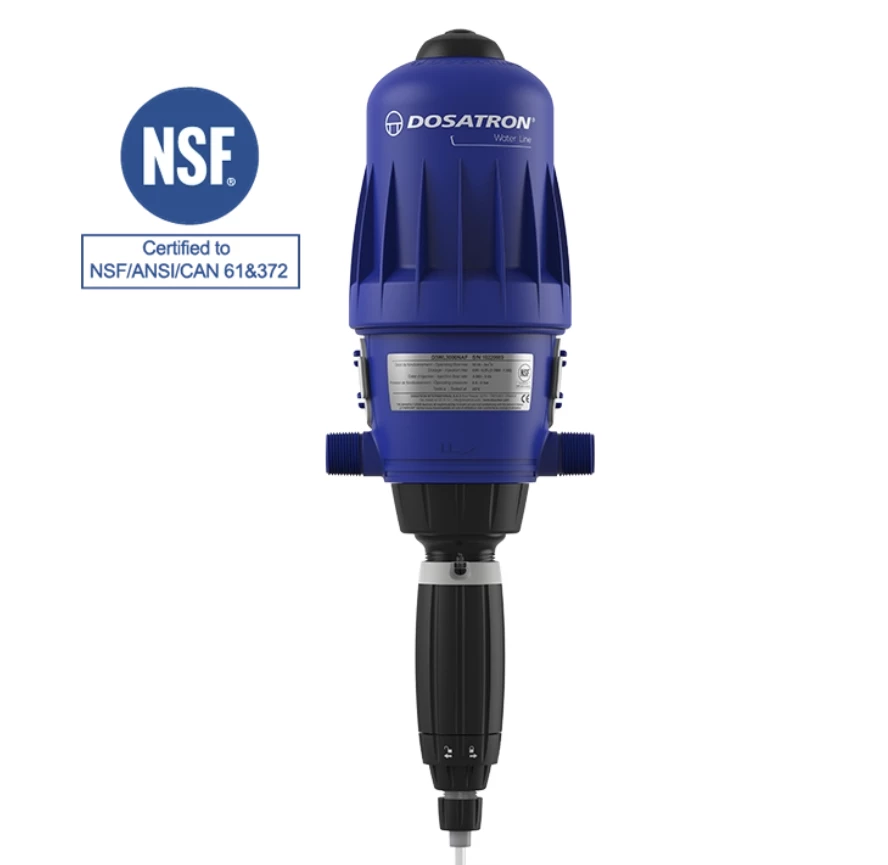
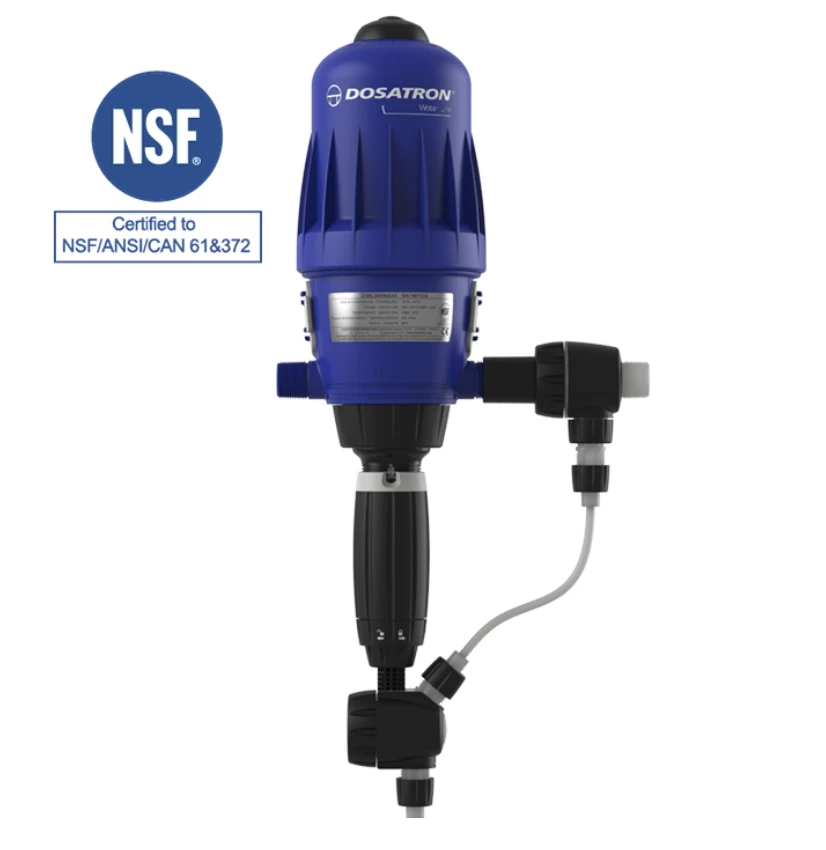
D3WL3000 for chlorine dosing duty ranges typically associated with water treatment. Published specifications for the D3WL3000 family commonly indicate operation over approximately 10 to 3000 l/h water flow and 0.5 to 6 bar, with injection ranges around 0.03% to 0.3% depending on configuration. These values must be validated against the exact model and site conditions.
D3WL3000 IE NSF for drinking-water oriented chlorination contexts where third-party certification can be required by project specifications. Dosatron documentation indicates NSF/ANSI/CAN 61 certification for this model family, which is relevant for components in contact with drinking water in certain markets.
Field feedback: limits, diagnostics and next steps
What proportional systems do well
Mechanically proportional dosing is inherently robust against flow variability because the injected volume is mechanically linked to carrier flow, without requiring external sensors. In many field contexts, this simplicity can reduce commissioning complexity and avoid issues related to signal integrity, power availability or instrument maintenance.
Where accuracy still degrades
Even with proportional architecture, accuracy can degrade when operation occurs near minimum flow, when suction refill is compromised (viscosity, long suction lines, air ingress), when check valves foul or wear, or when network head losses evolve (filter clogging, scaling). Diagnosing these cases is more reliable when operators correlate events (flow changes, pressure readings, chemical consumption trends) rather than relying on a single residual measurement.
One-line perspective for the future
Future improvements typically come from lightweight diagnostics (pressure logging, water meter trending, chemical mass tracking) and better correlation with sampling strategy, to distinguish genuine injection limitations from process demand effects.
Key takeaways for stable dosing under variable flow
Engineering checklist for repeatable ratio control
Maintaining proportional chemical dosing accuracy on variable-flow water networks requires controlling three coupled domains: hydraulics, pressure dynamics and additive behavior. Accuracy is preserved when the dosing device operates within its flow/pressure envelope, network transients and evolving pressure losses are managed, and the chemical suction side is engineered to ensure complete chamber refill under worst-case viscosity and temperature.
Many perceived "accuracy problems" are actually mixing, reaction-demand or sampling issues. Separating injection ratio verification (mass balance) from process residual validation (chemistry and contact time) is essential for correct root-cause identification.
Conclusion and request for quotation
Bottom line: stable proportional dosing on variable-flow networks is achievable when hydraulic limits are respected, transient pressure behavior is controlled, suction refill is secured and chemical compatibility is designed in from the start. If you need support to size, specify or commission a proportional dosing solution for disinfection or industrial water treatment, contact DOSATRON International to request a quotation tailored to your operating envelope and chemistry.