Use case
0.03% proportional chemical injection on low-pressure industrial water loops (power-free, centralized dosing)

This project addresses companies looking for:
On low-pressure industrial process-water loops, keeping an ultra-low dosing ratio stable is challenging: pressure and flow fluctuations can quickly lead to under-dosing or over-dosing when the target is only 0.03% (1:3000). This use case shows how a typical industrial site can secure repeatable chemical treatment using DOSATRON's water-powered proportional dosing pump D9IL3000, designed to stay proportional without any electrical supply at the injection point.
Description of the use case / service / project
Use case overview: proportional chemical injection at 0.03% on a low-pressure process loop
This is a use case (application example) describing a typical industrial configuration where chemical injection must remain strictly proportional on a centralized process-water distribution loop, even when operating conditions are unstable.
1) The problem: 0.03% dosing becomes unstable when pressure and flow fluctuate
Typical customer context
- Industry profile: industrial site with a centralized process-water loop (distribution skid feeding multiple points of use).
- Operating constraint: injection point located on a network that can run at low line pressure and variable flow.
- Energy constraint: the dosing point must operate without external electrical power (no local power, simplified safety/installation, or reduced maintenance requirements).
Measured / specified technical target
- Required injection ratio: 0.03% (equivalent to 1:3000), an extremely small proportion that is sensitive to any deviation.
- Hydraulic envelope to cover:
- Operating pressure: down to 0.15 bar.
- Flow range on the loop: from 500 l/h up to 9 m3/h.
Why this creates a real control risk on process loops
- Under-dosing risk: insufficient chemical concentration can reduce treatment effectiveness (for example corrosion inhibition, biocide action, or process conditioning), leading to variability and quality drift.
- Over-dosing risk: excessive additive consumption increases OPEX, can create downstream incompatibilities, and may destabilize the process.
- Repeatability risk: on a centralized loop feeding several users, non-proportional injection reduces consistency across the distribution network.
- Operational risk: reliance on electrical dosing devices at a remote injection point can add installation constraints and potential downtime in industrial environments.
2) The solution: a water-powered proportional dosing pump configured for ultra-low ratio injection
Selected equipment
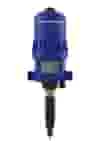
A water-powered proportional dosing pump was selected and configured to maintain 0.03% injection while staying proportional to the passing volume, without requiring external electricity. In this use case, the recommended model is the DOSATRON D9IL3000.
How the solution matches the operating envelope
- Ultra-low proportionality window: adjustable 0.03% to 0.2% (ratio 1:3000 to 1:500), enabling the exact 0.03% setpoint while keeping proportional dosing behavior.
- Low-pressure compatibility: designed to operate from 0.15 to 8 bar, supporting low-pressure loops and avoiding loss of dosing control at low head.
- Loop throughput coverage: suitable for 500 l/h to 9 m3/h, maintaining proportional injection across wide flow variability.
- Stable concentrate feed capacity: concentrate injection specified at 0.15 to 18 l/h, supporting very small ratios while remaining responsive to flow swings.
Key technical benefits for engineers and maintenance teams
- True proportional dosing (flow-synchronous): the injected volume automatically tracks water flow changes, reducing the risk of dilution drift when users open/close valves on the loop.
- No external electrical power: simplifies installation on skids and remote areas, and reduces dependencies (cabling, motor drives, local panels).
- Improved process repeatability: stable dosing ratios improve treatment consistency across the loop, which can translate into fewer deviations and more predictable chemical consumption.
- Fit for centralized distribution skids: supports centralized injection architectures where multiple process demands drive frequent hydraulic fluctuations.
Implementation notes (typical integration points)
- Install the dosing pump on the centralized skid in a location that ensures stable suction conditions for the concentrate and easy access for setting verification.
- Validate that the network's minimum pressure and minimum flow remain within the specified operating range to guarantee proportionality at the 0.03% setpoint.
- Select seal configuration compatible with the injected chemical (acidic or alkaline service options are commonly used on industrial additives).
Related company
This solution is provided by DOSATRON, manufacturer of non-electric proportional hydraulic metering pumps for industrial water treatment and dosing applications. See the company page: DOSATRON on ForaIndustry.