Power-free chlorination on drinking water networks is typically deployed on remote or resilience-critical sites where electricity is unavailable, unreliable, or excluded by design. The technical challenge is to maintain a stable disinfectant dose (most often sodium hypochlorite) across real hydraulic variations (flow, pressure, transients) while keeping the installed configuration compliant with potable-water requirements (materials in contact with water, certified accessories, auditability). This article details the main drivers of dosing stability, the most common compliance constraints (NSF/ANSI 61 and the EU drinking water framework), and the maintenance checkpoints that most directly impact repeatability and life-cycle cost.
Why power-free chlorination is used
Typical use cases and constraints
Chlorination on drinking water lines is frequently implemented on sites where electrical power is unavailable, unstable, or deliberately avoided: rural distribution branches, reservoirs, booster stations, construction bypass lines, emergency interconnections, and temporary commissioning setups.
The objective is simple in principle but demanding in execution: inject a disinfectant (commonly sodium hypochlorite) into a pressurised potable water main while keeping the applied dose stable despite variations in flow rate and pressure, and while maintaining conformity of all parts that can affect drinking-water safety (materials, seals, fittings, and assembly practices).
Main stability issues without electricity
Why "simple" solutions often drift
On electrified installations, metering pumps (diaphragm or peristaltic) are typically controlled by a flow signal (pulse output, 4–20 mA transmitter, PLC logic). When that control architecture is removed, operators often turn to passive or semi-passive approaches (tablet erosion, gravity drip, constant-feed devices). These can be workable, but they often introduce compromises in dose accuracy, repeatability, and maintenance workload.
Hydraulic variability is the primary disturbance
A drinking water line rarely operates at a single steady state. Night/day consumption cycles, valve operations, tank filling sequences, pump starts/stops, and pressure reducing stations make both flow and pressure dynamic. In power-free configurations, the most frequent issues observed in the field are:
dose drift when flow changes,
under-dosing at low pressure or low flow,
over-dosing after hydraulic transients,
loss of prime / gas-lock when hypochlorite releases gas in the suction circuit.
Chemistry-specific effects of sodium hypochlorite
Sodium hypochlorite solutions can degrade over time and may generate gas, which directly affects suction conditions and the repeatability of small injected volumes. In addition, chlorine demand can vary with raw water quality (organics, ammonia, iron/manganese), so a "fixed dose" assumption can yield fluctuating residual even if the injection device is stable.
Regulatory and certification constraints
Drinking water obligations in France and the EU
In France, drinking water supplied to the public must be safe and wholesome, under the obligations defined in the French Public Health Code (Code de la sante publique, Article L.1321-1). Operational monitoring and analytical programs for water distributed through networks are defined by the Arrete du 11 janvier 2007 (and its updates), which frames the control approach applied to distribution systems.
At EU level, the Drinking Water Directive (EU) 2020/2184 reinforces requirements on risk-based water safety management and includes an EU framework for materials in contact with drinking water (migration limits, positive lists and related conformity logic).
NSF/ANSI 61: what it covers (and what it does not)
For projects specifying North American approvals, NSF/ANSI/CAN 61 is widely referenced for components in contact with drinking water. It is a health-effects standard focused on evaluating whether contaminants can migrate from materials/products into water above acceptable levels, and it is not a performance standard for treatment claims. This distinction matters during procurement and audits: material conformity does not automatically validate dosing accuracy or disinfection performance. Official scope explanations are available from NSF.
Chemical quality: sodium hypochlorite specification
Where an operator specifies the hypochlorite used for potable water production, the relevant product standard in Europe is commonly NF EN 901 (sodium hypochlorite for water intended for human consumption). The normative reference is maintained by AFNOR (NF EN 901). In practice, aligning chemical quality, storage conditions and dosing hardware compatibility is essential to reduce gas-related instability and injector fouling.
Water-powered proportional dosing: the technical basis
How proportionality is achieved without electricity
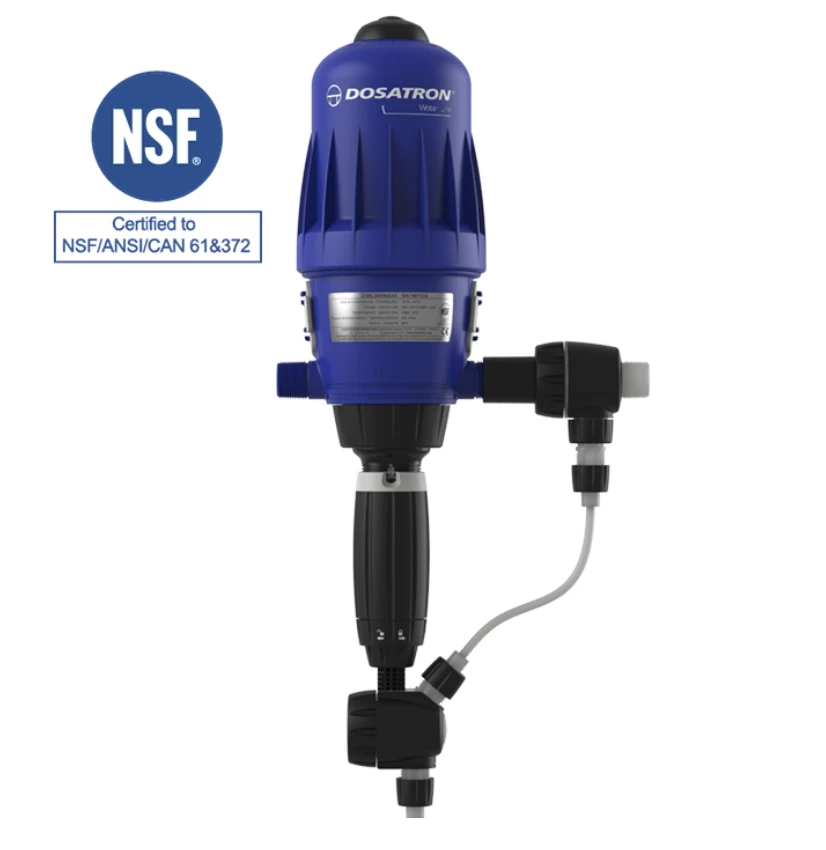
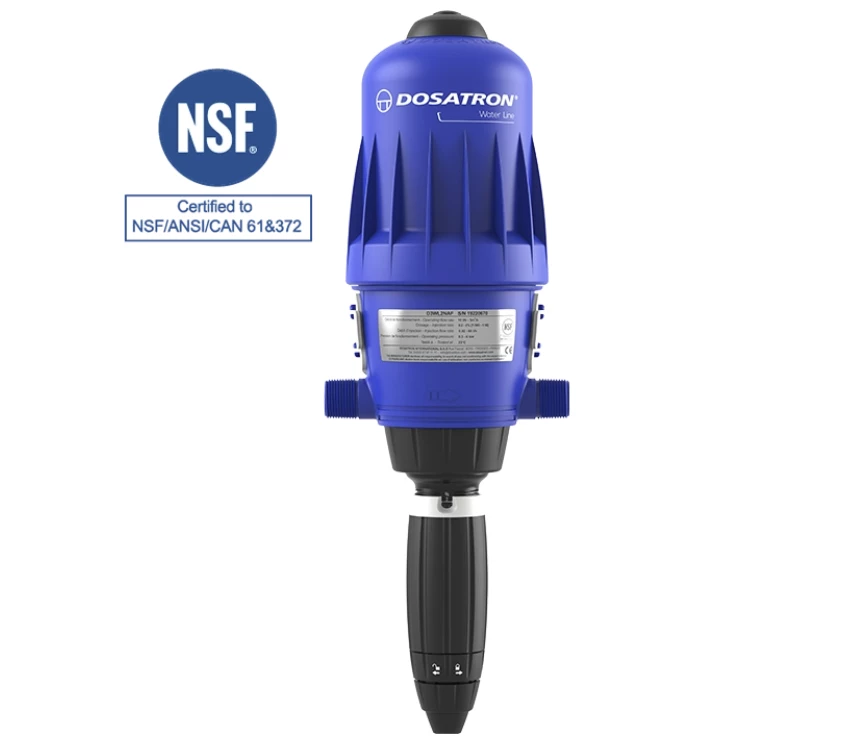
A water-powered proportional dosing pump uses the hydraulic energy of the line itself to actuate a motor piston/diaphragm coupled to the dosing mechanism. The injected volume is mechanically linked to the volume passing through the motor, enabling an inherently proportional dose: when flow increases, the device cycles faster, and injection increases accordingly. This operating principle is documented by the manufacturer as a water-driven, passive volumetric dosing technology operating without external power. Reference descriptions are available on the Dosatron technology overview.
Engineering stability: sizing the real operating envelope
In the field, stable proportional dosing depends on correctly engineering four parameters against the site's hydraulic envelope:
Available pressure range, including low-pressure periods and transient behaviour;
Flow range and dynamics (slow daily variations versus fast transients);
Target injection ratio (often set as % injection of a stock solution, then converted to mg/L as Cl2 according to concentration);
From a practical commissioning perspective, the most stable installations reduce suction losses and prevent air ingress: short suction line, chemically compatible foot valve/strainer, and leak-tight fittings. For hypochlorite, minimising heat/light exposure at the stock tank helps reduce decomposition and gas release, which in turn stabilises the suction circuit.
Setting and verifying the dose in practice
With proportional systems, the operator sets an injection ratio rather than a constant L/h. Commissioning should include an on-site proportionality verification such as a drawdown test (chemical level decrease versus metered water volume) to confirm the ratio in the real hydraulic conditions. Final water quality verification remains residual-based (free chlorine checks at representative points), but a stable proportional mechanism ensures residual variations are primarily driven by demand changes rather than flow-driven dosing drift.
Maintenance checkpoints that drive reliability
Injection point, check valves and crystallisation
Chlorine service is mechanically and chemically unforgiving. Common failure modes include scaling at the injection point, crystallisation during shutdowns when solutions dry, and check-valve sticking or leak-back. The layout should therefore include:
isolation/bypass for the dosing point,
serviceable injection check valve,
accessible strainers,
flush capability (water flush) to reduce crystallisation risk during planned stoppages.
Materials compatibility and avoidable "hidden air"
Hypochlorite is oxidative and can be incompatible with some elastomers and metals. Even when materials are selected correctly, deposits at the injector and check valve remain a routine reality. Maintenance plans should explicitly define:
injector inspection/cleaning frequency (linked to water hardness and stock concentration),
check-valve replacement criteria (loss of prime, leak-back, unstable drawdown),
suction line integrity checks to eliminate micro-leaks that let air in without visible liquid leakage.
For proportional chlorination where drinking-water conformity constraints are specified and power at the dosing point is not desired, the product range includes D3WL2 NSF and D3WL3000 IE NSF.
For project support and configuration consistency (pump variant, seals, injector, tubing scope), contact DOSATRON to align the dosing solution with the hydraulic envelope, chemical conditions, and required conformity documentation.
Conclusion
What makes power-free chlorination robust
Power-free chlorination of drinking water mains is technically robust when three elements are treated as a single engineered system: (1) hydraulic sizing that preserves proportionality across minimum pressure/flow, (2) compliance control for materials and accessories within the required certification scope (NSF/ANSI 61, EU/French potable-water constraints), and (3) chlorine-specific maintenance design focused on injectors, check valves, suction tightness and flushing strategy.
To secure repeatable dosing on non-electrified sites and reduce operational drift, request a configuration review and quotation from DOSATRON for your target flow/pressure range, required injection ratio, and conformity expectations.