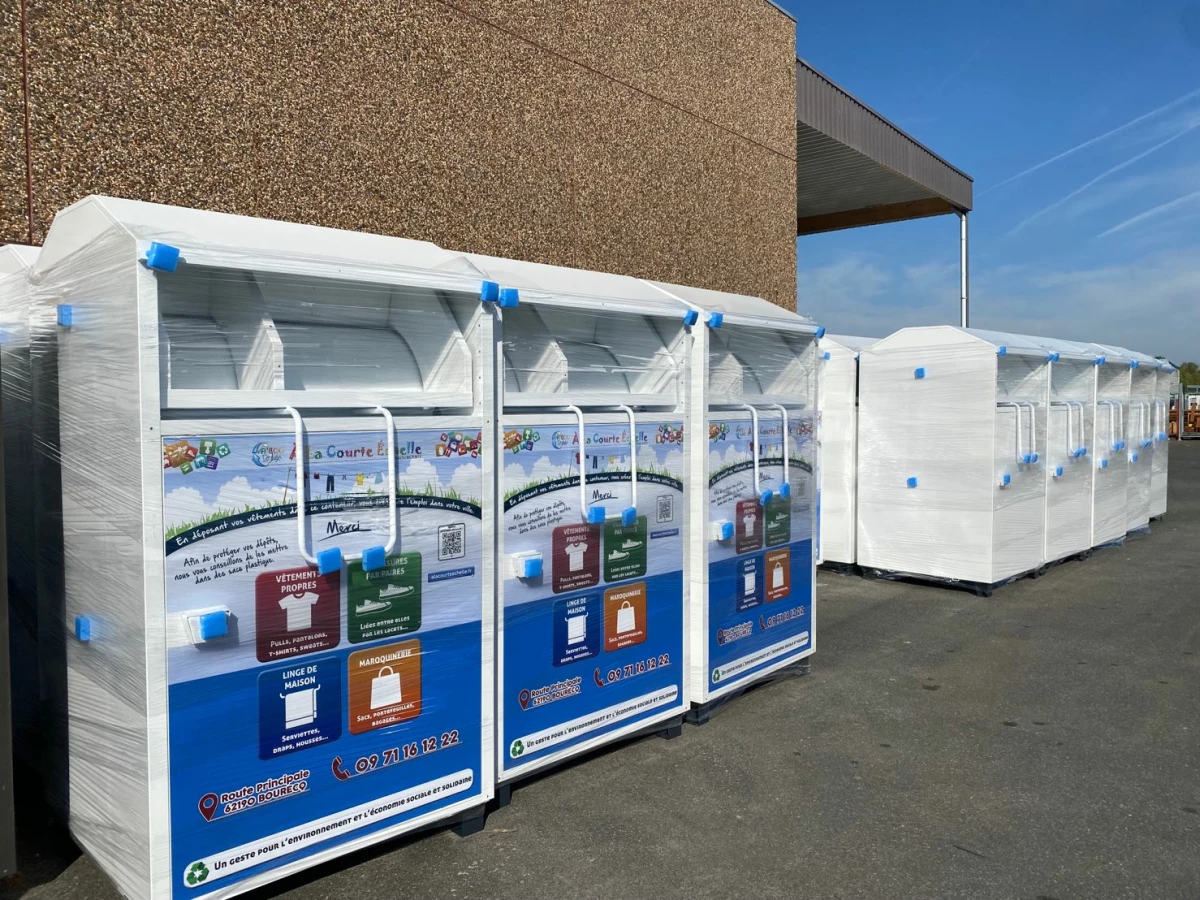
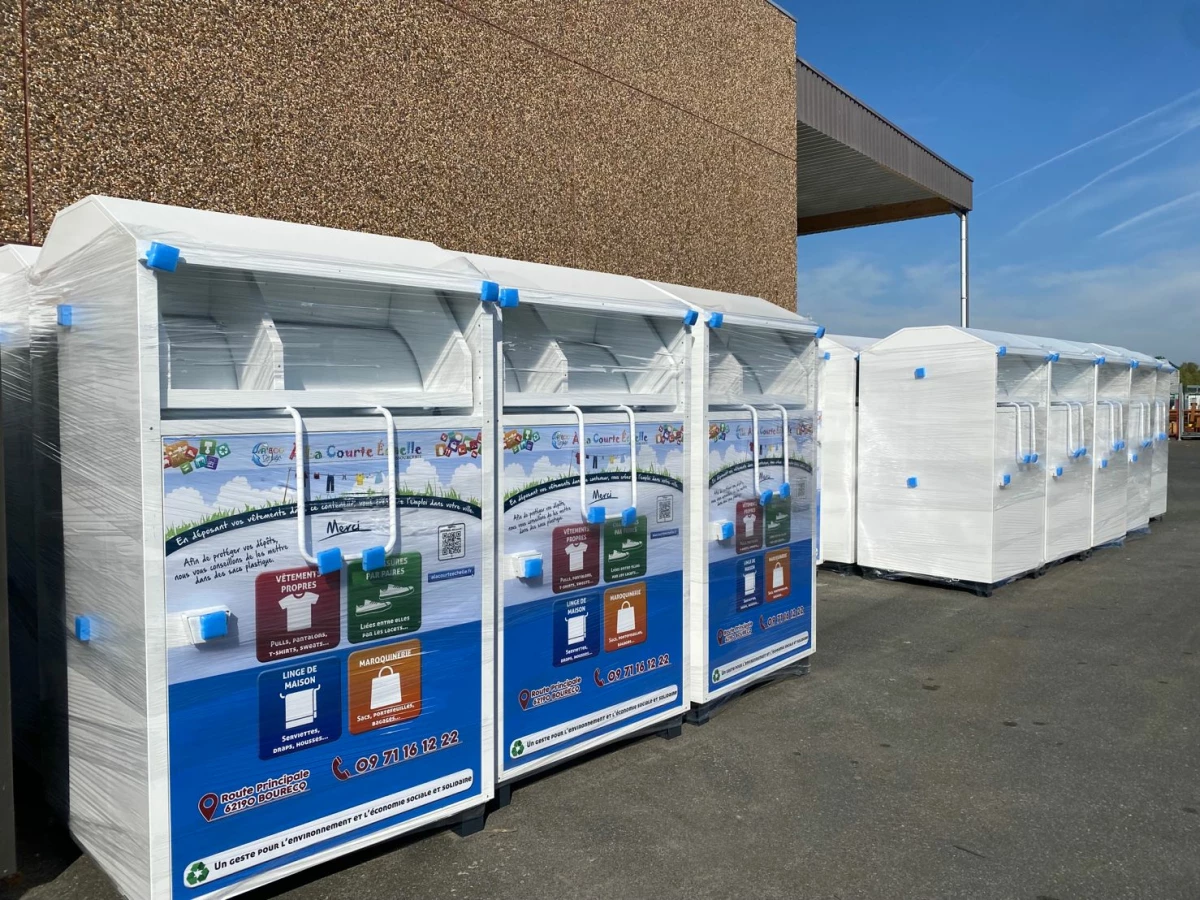
Textile drop-off point operators (municipalities, EPR schemes, waste contractors and facility managers) often face two recurring constraints: maintenance downtime caused by non-serviceable containers (door, hatch or lock failures) and insufficient useful volume that increases collection rounds and overflow risk. This application-focused use case shows how Econox addresses both issues with its Hybrid Range: modular textile banks assembled with rivets/bolts, designed for spare-part replacement, and available up to 3.6 m3.
Description of the use case / service / project
Context: outdoor textile drop-off points exposed to intensive public use
This page is an application-oriented use case (not a named end-customer project). It addresses operators managing outdoor textile collection points with repetitive user interactions and high mechanical solicitation:
Municipalities and local authorities
EPR schemes (extended producer responsibility) and delegated operators
In these environments, containers undergo frequent door openings, deposit hatch actuations and repeated filling cycles, which accelerates wear at the most stressed interfaces.
The problem: maintenance bottlenecks and insufficient useful capacity 1) Downtime caused by non-serviceable container architectures
On conventional textile banks, typical failure/damage points are well identified in the field:
Deposit hatch mechanism
Main door
Base and hinge area
Locking hardware
When the design is not serviceable, a localized failure can force a heavy repair (workshop-level) or even replacement of the entire unit. For operators, this creates direct operational risks:
Longer unavailability (downtime) due to repair logistics or full-unit replacement.
Higher maintenance cost because the intervention scope cannot be limited to the failed sub-assembly.
Progressive rigidity loss if repetitive stresses are not managed at the door/base interfaces (risk of deformation, misalignment and recurring failures).
These effects are amplified on high-traffic sites where stress accumulation is faster due to frequent actuation cycles.
2) Limited useful volume increases collection rounds and overflow risk
In parallel, insufficient useful volume on saturated sites creates a second constraint that directly impacts route performance:
More collection rounds, increasing operating cost and CO2 per tonne collected.
Higher overflow probability, which can lead to site pollution, complaints and degraded collection quality.
Lower route efficiency (more stops for the same recovered mass).
This use case explicitly contrasts a 2 m3 configuration with an extended version up to 3.6 m3 for sites constrained by peak deposit rates or collection frequency.
The solution: Econox Hybrid Range modular textile banks (riveted/bolted construction)
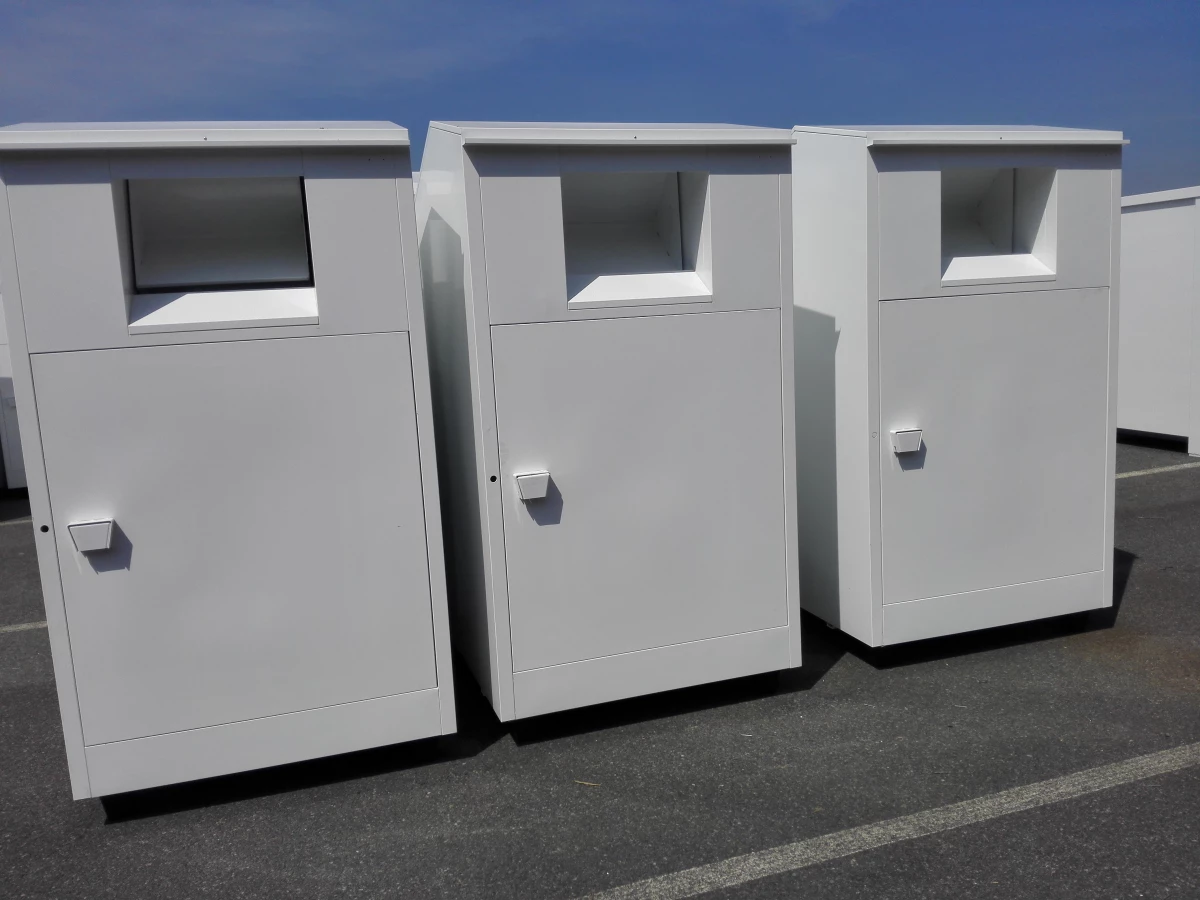
Econox answers these constraints with its Hybrid Range of textile banks engineered as modular assemblies fixed with rivets or bolts. The design intent is clear: spare-part serviceability, meaning each part can be replaced individually to reduce downtime while maintaining structural rigidity.
Design principles focused on maintenance, robustness and field serviceability
Modular, serviceable assembly: riveted/bolted architecture enabling targeted replacement of sub-assemblies instead of heavy intervention on the full container.
Reinforced door and base areas: designed to withstand repetitive user interactions that concentrate stress around the door/base structure and locking components.
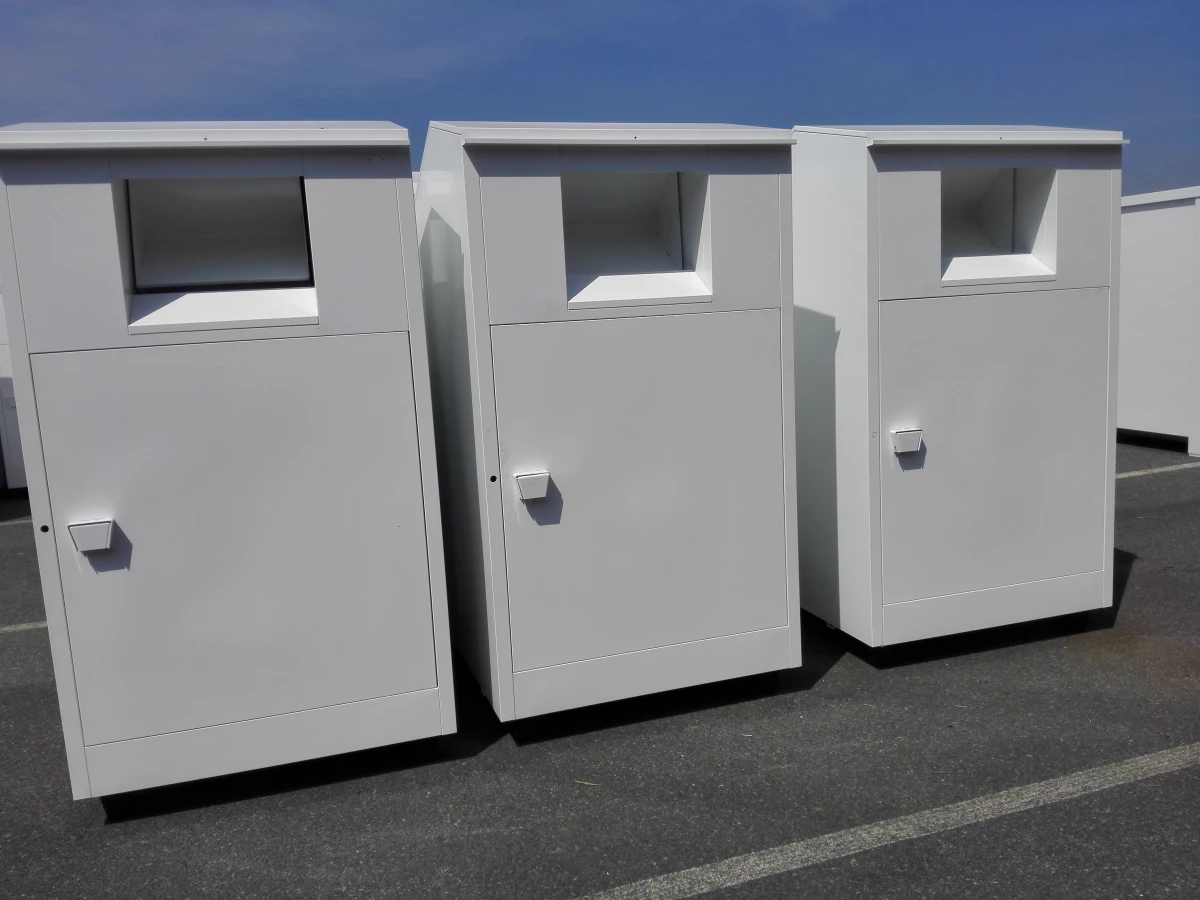
Steel cabinet: 1.25 mm galvanized or electro-galvanized steel depending on configuration.
Surface protection: epoxy coating (specified as "80" in the use case content).
Clean external finish: no visible screws or bolts, supporting durability and consistent appearance in public spaces.
Standard footprint configuration (baseline useful volume: 2 m3)
Overall dimensions: 1145 mm (W) x 1145 mm (D) x 2193 mm (H).
Locking: 5-point locking system with retractable handle.
Support: steel feet.
Typical mass: 150 kg.
Deposit hatch options to match user ergonomics and reduce hang-ups
To adapt to site usage and accepted bag formats, Econox offers multiple deposit access systems, specified with a vertical drop approach to limit hang-ups:
4-blade roller: bag opening 520 mm x 455 mm.
Swing hatch with handle: bag opening 1050 mm x 419 mm.
Large roll with handle: bag opening 1050 mm x 300 mm.
Big Size variant (useful volume up to 3.6 m3) to reduce collection frequency
For high-deposit locations or routes with limited collection frequency, the deeper "Big Size" model increases buffer capacity while keeping the same modular serviceability principle:
Useful volume: 3.6 m3 (vs 2 m3 baseline).
Overall dimensions: 1145 mm (W) x 1645 mm (D) x 2193 mm (H).
Why the riveted modular architecture matches the initial constraints Maintenance impact (availability and lifecycle costs)
Reduced repair downtime: the operator can replace the damaged module (door, hatch, hardware, panels) instead of immobilizing the entire unit for heavy repair.
Cost containment potential: modular spare parts reduce the intervention scope (depending on maintenance organization and spare-part stocking strategy).
Durability on high-traffic sites: reinforced door/base design directly addresses the rigidity-loss risk linked to repetitive mechanical stress.
Collection performance impact (route efficiency and overflow control)
Capacity scaling by constraint: moving from 2 m3 to 3.6 m3 increases the buffer against peak deposits, enabling fewer collection trips when routes are saturated.
Lower overflow probability: higher useful volume supports continuity of service on high-traffic locations.
Implementation notes: engineering checkpoints to specify the right configuration
Define the deposit profile: quantify peak deposit periods and confirm collection frequency constraints to choose between standard and Big Size volumes.
Select the deposit hatch: choose roller vs swing hatch vs large roll according to user ergonomics, accepted item size and anti-blocking requirements.
Build a spare parts strategy: the modular approach delivers maximum availability gains when critical sub-assemblies are identified and stocked according to common failure modes.
Supplier
Manufacturer: Econox company profile Additional reference:Metal fabrication capabilities and circular-economy equipment
Econox is a Lille-based manufacturer (since 2012) producing metal furniture for the circular economy, including textile/waste drop-off points and collection containers, with in-house processes spanning cutting/punching, welding, bending and surface painting.